

TL;DR
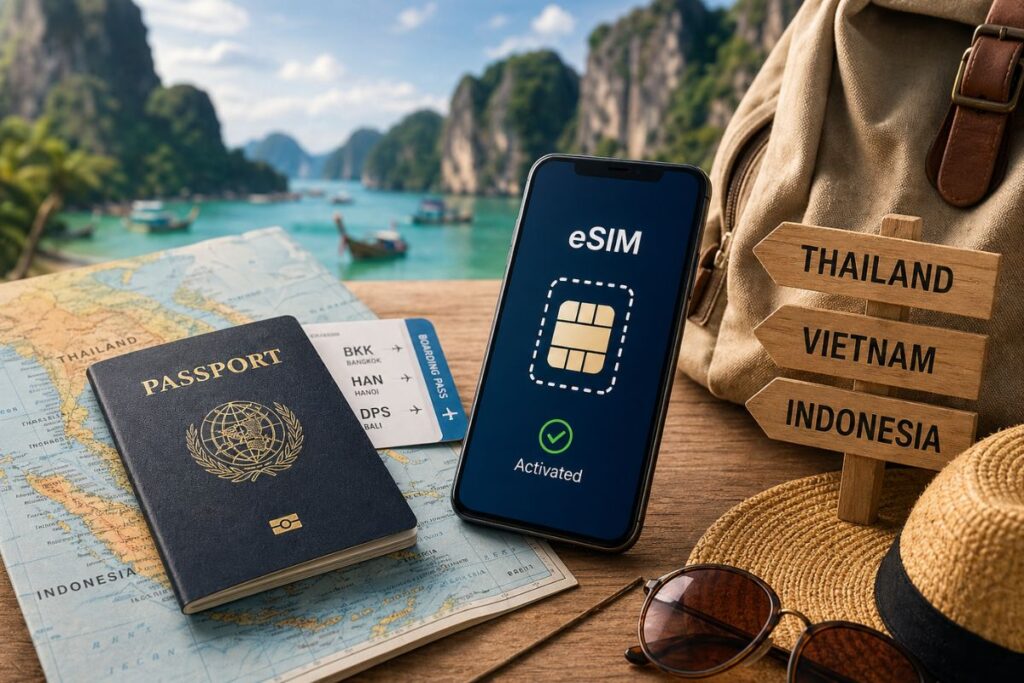
For most modern travelers, a Thailand, Vietnam and Indonesia eSIM is the more flexible and efficient choice compared with buying separate local SIM cards in each country. It saves time, removes the stress of finding a kiosk after landing, and makes it easier to stay connected across a multi-country trip. For gap year students, road trippers, eco-tourists, and digital nomads, the biggest advantage is convenience without giving up control. You can activate service before takeoff, choose an Esim package that matches your route, and avoid the friction of switching providers every time you cross a border. Local SIMs can still work for travelers who stay in one country for a long period and want to manage everything on the ground, but for most people moving through Thailand, Vietnam, and Indonesia, eSIM is now the smarter travel tool.
Why this comparison matters more than ever
Southeast Asia remains one of the most exciting regions in the world for independent travel. Thailand draws people in with its islands, co-working hubs, and food culture. Vietnam offers a mix of cities, mountain loops, beaches, and deep history. Indonesia gives travelers everything from Bali’s digital nomad scene to volcanic landscapes and remote islands. The common thread between all three is that travelers rely heavily on mobile data to make the journey work smoothly.
Maps, ride-hailing apps, translation tools, accommodation bookings, digital payments, ferry schedules, bus tickets, and remote work all depend on stable connectivity. A connection problem is no longer a minor inconvenience. It can affect safety, time, and budget. That is why the question is no longer just how to get connected. The real question is which option gives you the most practical value throughout a multi-country journey.
That is where the debate between local SIM cards and eSIM solutions becomes important. On paper, both offer mobile data. In reality, they create very different travel experiences.
The local SIM route: familiar, but often inefficient
For years, travelers arriving in Southeast Asia usually bought a local SIM at the airport or from a convenience store after arrival. It became the standard backpacker ritual. In some cases, it still works perfectly well. If you are spending a month or two in one country, do not mind comparing carrier options, and are comfortable swapping physical cards, then a local SIM can be a workable solution.
The issue begins when your journey is not limited to one destination. A local SIM strategy becomes more fragmented the moment your itinerary includes Thailand, Vietnam, and Indonesia in one trip. Instead of one simple setup, you now need to research three different markets, compare plans three times, register repeatedly, switch SIMs, and monitor separate balances or top-ups. That process may not seem difficult when described in a sentence, but it becomes tedious when you are jet-lagged, moving between airports, or trying to catch a ferry, night bus, or domestic flight.
There is also the uncertainty factor. Not every traveler lands at a major airport with a clear and easy telecom setup. Not every kiosk has straightforward pricing. Not every seller explains limits clearly. Some plans look cheap but come with short validity windows, speed caps, or confusing activation steps. If your priority is to start navigating immediately after landing, local SIM shopping can feel like an obstacle rather than a solution.
Why eSIM fits the way people travel now
A Thailand, Vietnam and Indonesia eSIM aligns far better with the expectations of today’s traveler. The biggest advantage is that it is built for movement. You can arrange connectivity before you leave home, keep your primary number active if your device supports it, and land with data already ready to use. That changes the first hour in a new country completely.
Instead of searching for a SIM booth, you can book transport, message your host, check directions, and confirm your next reservation the moment the plane lands. For digital nomads, that means less downtime. For gap year travelers, that means less stress. For eco-tourists and road trippers, that means better access to route planning, weather updates, and local recommendations without delay.
An eSIM also feels more natural because travel is increasingly planned online from start to finish. Flights are booked in apps. Accommodation is managed online. Travel insurance is purchased digitally. It makes sense that mobile data should work the same way. A well-designed Esim package fits into that digital-first travel flow.
Comparing convenience: one setup versus repeated setup
The strongest case for eSIM is convenience, but not in a superficial way. This is operational convenience. It reduces the number of decisions you need to make while moving across borders. A traveler visiting Bangkok, Hanoi, Ho Chi Minh City, Bali, and Yogyakarta does not want to stop and reconfigure mobile access every few days. They want continuity.
With local SIMs, every arrival can create another admin task. You need to remove your old SIM, store it somewhere safely, install the new one, follow local instructions, and possibly face language or registration barriers. If something does not work immediately, you may spend valuable time troubleshooting.
With eSIM, the process is usually cleaner. You scan, install, activate, and move on. That simplicity matters more than people realize. The easier your connectivity is, the more mental energy you keep for the trip itself.
HOAM eSIM’s country-specific simplicity versus bloated regional packages
One of the most important points in this discussion is that not all eSIM options are equally useful. Some competitors promote broad regional packages that sound impressive because they cover many countries. The problem is that these packages can become bloated. They are designed to look comprehensive, but they may include countries you never plan to visit, data amounts that do not match your actual usage, or pricing structures that make you pay for excess flexibility you do not need.
That is where HOAM eSIM takes a more practical path. Instead of forcing travelers into oversized regional bundles, it emphasizes country-specific simplicity. This approach makes a lot of sense for people who already know their route and want a solution tailored to real travel patterns, not generic marketing promises.
A traveler going specifically through Thailand, Vietnam, and Indonesia usually wants clarity. They want to know what they are paying for, how much data they get, and whether the setup fits their exact journey. They do not need a package padded with irrelevant extras. They need something direct, transparent, and usable.
That kind of focus is especially valuable for budget-conscious travelers. Gap year students and long-term travelers are constantly balancing cost and function. Paying for a bloated plan may not be disastrous, but it is rarely efficient. A more tailored option feels smarter because it respects the way people actually travel.
Web-based activation before takeoff changes the whole travel experience
One of the clearest advantages of an eSIM is the ability to activate it online before departure. This is not just a convenience feature. It is a strategic advantage. It lets you start your trip in control.
Imagine landing late at night in Bangkok after a long-haul flight. Or arriving in Ho Chi Minh City during a busy transit window. Or touching down in Bali and needing to reach your driver immediately. In each case, web-based activation before takeoff removes a layer of uncertainty. You do not have to hope that there is an open telecom counter. You do not have to compare offers while carrying luggage. You do not have to rely on airport Wi-Fi to get your bearings.
This matters even more for road trippers and eco-tourists whose routes may involve less urban, less predictable environments. Reliable data from the start means access to directions, accommodation details, weather changes, and emergency communication when you need them most.
HOAM eSIM’s web-based activation model speaks directly to this travel reality. It recognizes that connectivity should begin before the journey becomes complicated, not after.
Custom data amounts that fit your journey
Another major problem with traditional mobile options is mismatch. Travelers often buy either too much data or too little. Local SIMs may push standard tourist bundles that do not reflect your actual habits. Some regional eSIM products do the same. They offer fixed tiers that are easy to market but not always easy to justify.
Custom data amounts are a far better fit for real-world travel. A person spending most of the trip in cafés and hostels with Wi-Fi will not use data in the same way as a creator uploading videos daily or a remote worker taking calls on the go. A couple on a scenic trip through islands and rural areas may need steady navigation access but not unlimited usage. A backpacker on a strict budget may want just enough data to stay functional between Wi-Fi stops.
This is where HOAM eSIM becomes commercially persuasive in a way that still feels useful rather than aggressive. Custom data amounts allow travelers to match spending with behavior. That creates better value, less waste, and more confidence in the purchase. It turns the Esim package from a generic product into a practical travel tool.
The real challenge of coverage, especially when routes become more complex
Travelers often assume Southeast Asia is simple from a connectivity perspective because Thailand, Vietnam, and Indonesia are all major tourism markets. In reality, coverage needs can still vary based on your route. City connectivity is one thing. Inter-island transfers, mountain roads, remote beaches, and less urban regions are another.
This challenge becomes even more relevant when travelers start comparing Southeast Asia with wider Asia-Pacific routes that may extend into Oceania. Finding reliable coverage across different geographies can become messy fast. The more countries or remote destinations you add, the more exposed you are to fragmented telecom decisions. That is why travelers increasingly prefer solutions that reduce operational complexity from the start.
Even if your main journey is Thailand, Vietnam, and Indonesia, thinking ahead matters. Many modern travelers do not follow rigid itineraries anymore. They add stops, extend trips, and move fluidly. A connectivity setup that is simple and intentional is easier to adapt than one built on a chain of separate local purchases.
How competitors complicate the process
In general terms, many competitors make connectivity harder than it needs to be. Some overload travelers with technical language. Others present too many plan variations without helping users understand which one actually fits their trip. Some rely heavily on the appeal of giant regional coverage maps while offering less clarity about how practical the plan will feel on the ground.
The issue is not only price. It is cognitive friction. Travelers do not want to decode a telecom spreadsheet before a trip. They want a clean decision. The more complicated the offer looks, the more likely they are to delay the purchase or make the wrong one.
HOAM eSIM’s advantage in this context is not just that it sells eSIMs. It is that it frames connectivity around the traveler’s route and timing. That is a stronger business proposition because it removes friction at the point where people are most likely to abandon the process.
So which works best?
For most travelers moving through Thailand, Vietnam, and Indonesia, eSIM works best. It wins on flexibility, speed of setup, trip continuity, and ease of control. Local SIMs still have a place for people who settle in one country for a long stay and do not mind handling local telecom logistics on arrival. But for multi-country travel, the trade-off is usually no longer worth it.
A Thailand, Vietnam and Indonesia eSIM suits the rhythm of border-crossing travel. It supports people who want to move faster, plan better, and stay connected with less friction. When that eSIM is built around country-specific simplicity, web-based activation, and custom data amounts, it becomes even more compelling.
For travelers who care about time, energy, and practical value, the smarter option is the one that removes unnecessary obstacles. That is exactly why eSIM has become the preferred choice for so many modern travelers exploring Southeast Asia.
Final thoughts
Travel in Southeast Asia is often sold as spontaneous, free, and adventurous. That is true, but the best trips still rely on good infrastructure decisions. Connectivity is one of them. When you choose the right setup, the whole journey feels lighter. You move through airports faster, adapt to changes more easily, and stay focused on the experience rather than the logistics.
That is why the conversation is shifting away from simple price comparisons and toward overall travel efficiency. A local SIM may still look familiar, but familiarity is not the same as suitability. For a generation of travelers who expect mobility, customization, and digital convenience, the better answer is increasingly clear.
A thoughtfully chosen Thailand, Vietnam and Indonesia eSIM gives you that balance of flexibility and control. And when the provider keeps the process clean rather than bloated, the value becomes obvious.
FAQ
Is a Thailand, Vietnam and Indonesia eSIM better than buying a SIM card in each country?
For most multi-country travelers, yes. A Thailand, Vietnam and Indonesia eSIM is usually the better option because it removes the repeated hassle of buying and switching SIM cards in every destination. Instead of managing separate plans and dealing with airport kiosks or local activation steps, you can set up connectivity in advance and keep your trip moving smoothly. This is especially useful for travelers with packed itineraries, late arrivals, or work obligations on the road.
Who benefits most from an Esim package for Southeast Asia?
An Esim package is especially valuable for gap year students, road trippers, eco-tourists, and digital nomads because these travelers often move frequently and depend on data for navigation, bookings, communication, and remote work. Rather than treating connectivity as a separate task in every country, they can manage it as part of the trip planning process. That saves time and reduces friction, which matters a great deal when travel is flexible and fast-moving.
Are local SIM cards cheaper than eSIMs in Thailand, Vietnam, and Indonesia?
Sometimes local SIM cards may appear cheaper at first glance, especially for single-country stays, but the total picture is more nuanced. Multi-country travelers must factor in the repeated time, effort, and uncertainty involved in finding, comparing, registering, and topping up separate plans. An eSIM may offer better overall value because it reduces those hidden costs and provides a more seamless travel experience. For many travelers, convenience and continuity justify the difference.
Can I activate my Southeast Asia eSIM before my flight?
Yes, and that is one of the strongest benefits of choosing eSIM. Web-based activation before takeoff allows you to land with data ready to use, which means you can immediately access maps, transport apps, host messages, and booking information. This is particularly useful if you arrive at night, have a tight transfer, or are heading somewhere unfamiliar. Pre-departure activation gives travelers a stronger sense of control from the first moment of the trip.
Why do some regional eSIM packages feel confusing?
Many regional products are designed to sound comprehensive, but they often bundle together too many countries, fixed data structures, or unnecessary features that do not match a traveler’s actual route. This can make the selection process more confusing and the product less efficient. Travelers going specifically to Thailand, Vietnam, and Indonesia often prefer a cleaner, more focused solution that reflects their real itinerary instead of a broad package filled with irrelevant extras.
What should I look for when choosing an eSIM provider for Southeast Asia?
You should look for clarity, route relevance, easy activation, and data flexibility. The best provider is not simply the one with the biggest map or the loudest marketing. It is the one that helps you choose a plan that fits your actual journey without overcomplicating the process. Country-specific simplicity, web-based setup, and custom data amounts are all strong indicators that the product is built around traveler needs rather than generic telecom packaging.