

TL;DR
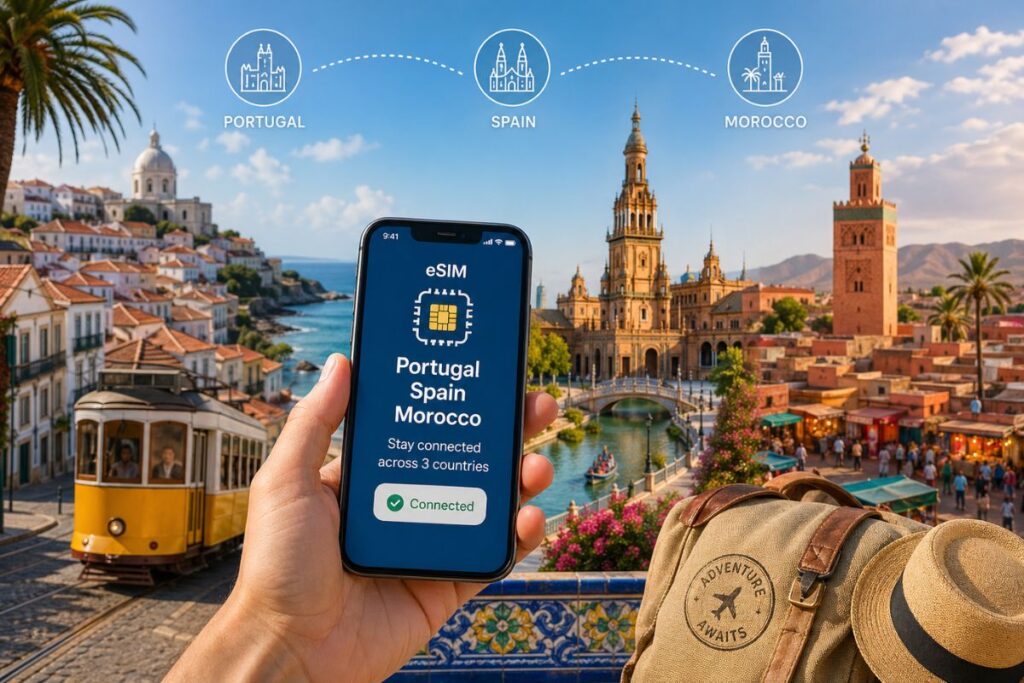
Traveling across Portugal, Spain, and Morocco can be one of the most rewarding multi-country journeys for modern travelers. You can move from Atlantic coastlines and historic Iberian cities to North African medinas and desert gateways in a single trip, but staying connected across all three countries is not always as simple as it sounds. A Portugal, Spain and Morocco eSIM gives travelers a more flexible and efficient way to manage data without swapping physical SIM cards, searching for local shops, or overpaying for oversized regional plans. For gap year students, road trippers, eco-tourists, and digital nomads, the right setup is not just about internet access. It is about convenience, cost control, route flexibility, and being ready before takeoff.
Why This Route Demands Smarter Connectivity
Portugal, Spain, and Morocco make a compelling travel combination because they offer contrast without requiring long-haul movement. You can begin in Lisbon, continue through Seville or Barcelona, and then cross into Morocco for Tangier, Marrakech, Fes, or beyond. The appeal is obvious. The connectivity experience is not always as seamless.
Many travelers assume that a Europe-focused plan will automatically solve everything for this route. That is often where problems begin. Portugal and Spain are commonly grouped together under European mobile coverage, but Morocco sits outside that standard expectation. That means travelers who choose broad regional plans without checking country-level support can end up with patchy service, roaming confusion, or unnecessary costs once they enter North Africa.
This is why a Portugal, Spain and Morocco eSIM matters. It addresses the real travel pattern instead of forcing travelers into a generic regional bundle that looks convenient on the surface but becomes inefficient the moment borders change.
The Real Challenge Is Cross-Region Travel, Not Just Data Access
The hardest part of staying connected on this route is not buying data. It is buying the right data plan for a trip that crosses both Europe and North Africa. Competitors often market large regional products as if more countries always mean more value. In practice, travelers do not need fifty destinations inside one bloated package if their actual trip only includes three carefully planned stops.
That mismatch matters. When a traveler pays for a large regional plan, they may be paying for countries they will never visit, data limits that do not match their usage style, or activation systems that are harder than they should be. A student on a budget does not travel like a remote worker who uploads video calls and cloud files all day. An eco-tourist traveling slowly through smaller towns may need reliable maps and messaging, but not heavy social media streaming. A road tripper may want navigation and hotspot flexibility without being forced into a premium price tier.
The better approach is country-specific simplicity. That is where HOAM eSIM positions itself clearly. Rather than overwhelming travelers with inflated regional choices, it focuses on straightforward travel logic. You choose what actually fits your journey, and you activate it without unnecessary complexity.
Why Country-Specific Simplicity Beats Bloated Regional Packages
For travelers comparing options, simplicity is not a minor feature. It is part of the value proposition. HOAM eSIM’s strength is that it reduces friction at the planning stage and during the trip itself. Instead of making users decode a complicated product matrix, it gives them a cleaner path to staying online where they actually plan to go.
A Portugal, Spain and Morocco eSIM works best when it reflects how people move. Some travelers spend one week across all three countries. Others stay two days in Portugal, ten days in Spain, and a month in Morocco. Some arrive in Europe first and continue south. Others start in Morocco and head north. A rigid, oversized regional plan does not adapt well to those real-world variations. A more focused Esim package does.
This is also where business logic becomes important. Good travel connectivity products are not only about technology. They are about product-market fit. Travelers do not want to feel like they are buying surplus inventory. They want transparency. They want to understand what they are paying for, where it works, and whether it matches the rhythm of their trip. Brands that simplify those decisions build trust faster, especially with globally mobile audiences who compare multiple providers before purchase.
Web-Based Activation Before Takeoff Changes the Entire Experience
One of the most practical advantages of eSIM travel is activation before departure. This is especially useful for travelers moving across countries with different arrival conditions, ferry crossings, train transfers, and late-night check-ins. The ability to set up service through a web-based process before takeoff removes a major point of stress.
Imagine landing in Lisbon and instantly calling a ride, opening a digital hotel check-in, or pulling up offline backups and live maps without hunting for airport Wi-Fi. Then imagine doing the same again when crossing into Morocco. That continuity matters. Travelers today rely on connectivity for far more than browsing. It powers transportation, payments, translation, accommodation access, security, and work.
Web-based activation is also a stronger fit for digital nomads and long-form travelers who plan ahead. Instead of depending on physical store hours or local SIM kiosks, they can prepare their connectivity on their own schedule. That makes the first hours in a new country more productive and less uncertain.
For gap year students, this can mean easier contact with family and fewer arrival-day mistakes. For road trippers, it means faster navigation and route adjustments. For eco-tourists, it means easier access to transport alternatives, trail information, and local booking platforms. For remote workers, it means less downtime between borders.
Custom Data Amounts Fit Real Journeys Better
Not every traveler consumes data the same way, and one of the most common flaws in travel telecom offers is the assumption that one data size fits everyone. In reality, a couple on a scenic route through southern Spain and northern Morocco may mainly use maps, translation tools, email, and occasional uploads. A content creator may need much more. A student backpacking on a budget may want strict control over spend.
That is why custom data amounts matter. Travelers should be able to choose a plan that reflects trip length, work needs, and budget instead of being pushed toward the largest available bundle. This is not only good for the customer. It is also better business. Flexible plan sizing creates a more relevant buying journey and improves conversion because the offer feels tailored rather than inflated.
A strong Portugal, Spain and Morocco eSIM should help travelers avoid two costly extremes. The first is underbuying and needing urgent top-ups at inconvenient moments. The second is overbuying a large package that leaves most of the allowance unused. HOAM eSIM’s more targeted model supports the kind of decision-making travelers actually want. It lets them match their data plan to the journey, not the other way around.
Why Competitors Often Make the Process Harder
Many competitors complicate the buying experience in subtle ways. They use long country lists to create the impression of scale. They present technical details before clear travel use cases. They bury important distinctions between coverage zones, activation timing, and plan structure. Some even make travelers compare multiple overlapping packages just to figure out which one supports their route.
This creates a frustrating customer journey. A traveler looking for a clear answer ends up sorting through oversized Europe plans, broader international bundles, and fine print that may not reflect a Portugal, Spain, and Morocco itinerary in a practical way.
In general terms, competitors tend to overcomplicate three things:
- Coverage logic by bundling too many destinations into one offer without making route relevance clear.
- Activation flow by requiring extra steps, unclear timing, or app-heavy onboarding.
- Plan sizing by pushing large, expensive packages that do not match how travelers actually use data.
A simpler brand experience stands out because it reduces cognitive load. That matters in travel purchases, where users are often booking flights, accommodation, activities, and insurance at the same time. The easier it is to understand and activate a product, the more likely the customer is to trust it.
Who Benefits Most From This Type of eSIM Setup
The appeal of Portugal, Spain and Morocco eSIM is especially strong for traveler profiles that value flexibility.
Gap year students often move quickly, change plans on short notice, and want a straightforward solution that does not require learning local telecom systems in every country. A digital eSIM setup reduces the learning curve and helps them manage cost.
Road trippers benefit because route changes are common. They may detour through smaller towns, coastal roads, or inland regions where dependable data matters for maps, accommodation, and coordination. Having a plan ready before entering each country keeps the journey smoother.
Eco-tourists often travel more intentionally and may spend time outside major urban centers. Connectivity helps with public transport apps, trail planning, conservation sites, local homestays, and low-impact travel decisions. A clean digital solution supports that mobility without adding unnecessary physical waste or store visits.
Digital nomads may have the highest expectations of all. They need consistency, quick setup, and enough flexibility to align with changing workloads. A plan that is easy to activate and easy to match to actual usage is far more valuable than a flashy global product that creates friction.
How to Choose the Right eSIM for This Route
When comparing options, travelers should look beyond the headline price. The smarter questions are about fit, clarity, and control. Before purchasing, it helps to evaluate the following:
- Does the plan clearly support Portugal, Spain, and Morocco as a realistic route rather than as part of an oversized generic package?
- Can it be activated online before departure?
- Are the data amounts flexible enough to match light, moderate, or heavy travel use?
- Is the buying process easy to understand without excessive comparison work?
- Does the product feel designed for travelers, or does it feel designed to upsell them?
These questions bring the focus back to the user experience. The best travel connectivity products are not simply the biggest. They are the ones that remove friction at the exact moments travelers need confidence.
Final Thoughts
Travel across Portugal, Spain, and Morocco is rich, dynamic, and increasingly popular with modern global travelers. It combines culture, coastline, cuisine, history, and movement across two regions in one journey. That kind of trip deserves a connectivity solution built for actual travel behavior, not generic telecom packaging.
A Portugal, Spain and Morocco eSIM offers a cleaner answer for travelers who want to stay online without dealing with physical SIM swaps, oversized roaming bundles, or confusing regional plans. HOAM eSIM’s country-specific simplicity, web-based activation before takeoff, and flexible data choices make it a strong fit for travelers who care about convenience and clarity. In a category where many providers overcomplicate the offer, simplicity becomes a competitive advantage.
For travelers planning smarter journeys, connectivity should not be an afterthought. It should be one of the easiest parts of the trip.
FAQ
What is the main advantage of using a Portugal, Spain and Morocco eSIM instead of buying local SIM cards?
The main advantage is convenience across borders. Instead of buying separate SIM cards in each destination, dealing with store visits, registration steps, or physical card swaps, travelers can activate one digital solution that supports their route more smoothly. This is especially useful on a multi-country journey where time, flexibility, and arrival-day simplicity matter. For travelers who want to move between Portugal, Spain, and Morocco without interruption, an eSIM reduces friction and helps them stay connected from the moment they land.
Is a regional Europe plan enough for trips that also include Morocco?
Not always. Many travelers assume that if Portugal and Spain are covered under a European plan, Morocco will be included too, but that is often not the case. Morocco changes the logic of the trip because it sits outside the standard Europe-only framing used by many telecom offers. That is why travelers should check whether their chosen plan actually reflects the full route. A dedicated Portugal, Spain and Morocco eSIM is often more practical than relying on a Europe-heavy package that may not align well with cross-region travel.
Why do flexible data amounts matter for travelers?
Flexible data amounts matter because travel styles vary widely. A gap year student using messaging apps and maps has different needs from a digital nomad attending video meetings or a road tripper using navigation every day. When providers only offer large bundles, travelers may end up overpaying for data they do not use. When the plan is too small, they risk disruptions and urgent top-ups. Flexible data sizing creates a better customer fit, supports budget control, and makes the overall product more useful in the real world.
Can I activate an eSIM before I fly to Portugal, Spain, or Morocco?
Yes, and that is one of the strongest advantages of a modern travel eSIM. Web-based activation before takeoff allows travelers to prepare connectivity before arriving, which makes the first hours in a new country easier. Instead of depending on airport Wi-Fi or local SIM shops, they can land with access ready for maps, transportation, bookings, and communication. For international travelers crossing multiple borders, this pre-trip setup creates a smoother and more reliable start.
How do some competitors make travel eSIMs more confusing than they need to be?
In general, competitors often add complexity by offering too many overlapping regional packages, unclear coverage rules, and oversized country bundles that do not reflect a traveler’s real itinerary. They may emphasize the number of destinations included rather than whether the plan actually fits the route. They may also complicate activation or push larger plans than necessary. This makes the buying process slower and less transparent. Travelers usually respond better to a simpler product structure that explains coverage, activation, and data options clearly.
Who should consider a Portugal, Spain and Morocco eSIM the most?
This kind of eSIM is especially useful for gap year students, road trippers, eco-tourists, and digital nomads because all of these traveler groups value flexibility. They often move across borders, change plans mid-journey, and depend on mobile data for navigation, communication, bookings, and daily logistics. A targeted eSIM setup helps them stay connected without wasting time or money on plans that do not match their route. For travelers who want a smoother multi-country experience, it is one of the most practical tools they can arrange before departure.